Editorial note: This article was revised in July 2026.
Why „Best“ Can’t Stand Still
Picture a small manufacturer that follows a „best practice“ for safety protocols drawn from an industry handbook. That makes sense — until a new law, such as the German Lieferkettengesetz (Supply Chain Act), requires far more thorough documentation from every supplier. Overnight, the company’s supposed best practice is outdated. It now faces legal exposure and no longer meets the state of the art.
Many SMEs are told that following „best practice“ or an official standard will protect them. Real-world experience shows otherwise: laws, technology, and industry guidelines all evolve faster than formal standards do. This article explains why knowledge management (KM) is essential for keeping pace with that change — how German courts weigh „state of the art“ against outdated norms, why best practice is a moving target rather than a fixed benchmark, and how SMEs can stay adaptable under this uncertainty.
1. The Myth of an Evergreen „Best Practice“
1.1 Best Practice as a Moving Target
„Best practice“ is often treated as a permanent seal of quality — as if a method or tool, once certified „best,“ stays that way. In reality, it only reflects a method’s success at a given point in time. As new technologies or regulations emerge, that same practice can become insufficient. Companies that cling to outdated practices risk inefficiency, legal liability, or reputational damage.
Case in point: a data-handling procedure that once satisfied ISO requirements may no longer meet a revised GDPR standard demanding stronger anonymization. What was „best“ yesterday does not automatically remain compliant today.
1.2 The Legal Doctrine Behind „State of the Art“: Germany’s Three-Tier Theory
The idea that „best practice“ can expire is not just a management observation — it is formalized in German law as the Drei-Stufen-Theorie (three-tier theory), established by the Federal Constitutional Court (Bundesverfassungsgericht) in its 1978 Kalkar decision on nuclear power plant licensing (BVerfG, Beschluss v. 08.08.1978, Az. 2 BvL 8/77). The court held that tying legal safety requirements to open-ended technical standards — rather than fixed, codified rules — allows the law to keep pace with technical development without constant legislative amendment. Three tiers emerged:
- Allgemein anerkannte Regeln der Technik (generally acknowledged rules of technology) — the lowest tier. To qualify, a technical rule must satisfy three components established in German case law tracing back to a 1910 Reichsgericht decision on construction law (RGSt 44, 75): it must be scientifically sound, practically tested and proven, and represent the prevailing view among the majority of practitioners in the field. Because this tier requires broad consensus, it structurally lags behind innovation — a rule cannot earn this status until it has already been through years of practical use.
- Stand der Technik (state of the art) — the middle tier. Unlike the tier above, it does not require the rule to already be broadly proven or accepted; feasibility (Realisierbarkeit) is enough. This is the standard German environmental and occupational-safety law binds parties to (e.g., § 3 Abs. 6 BImSchG, the Federal Immission Control Act; § 4 Nr. 3 ArbSchG, the Occupational Safety Act).
- Stand von Wissenschaft und Technik (state of science and technology) — the highest tier, reserved for the most safety-critical contexts such as nuclear law (§ 7 Abs. 2 Nr. 3 AtG). Here, not even technical feasibility is required — a well-founded scientific prognosis suffices. This tier is deliberately volatile: it changes as fast as scientific consensus itself does.
A parallel, related concept exists at EU level: the „Best Available Techniques“ (BAT) standard under the Industrial Emissions Directive, functionally similar to Stand der Technik but developed through a separate European process. It is worth distinguishing from „best practice“ in the everyday business sense used elsewhere in this article — BAT is a binding regulatory threshold, not a voluntary management recommendation.
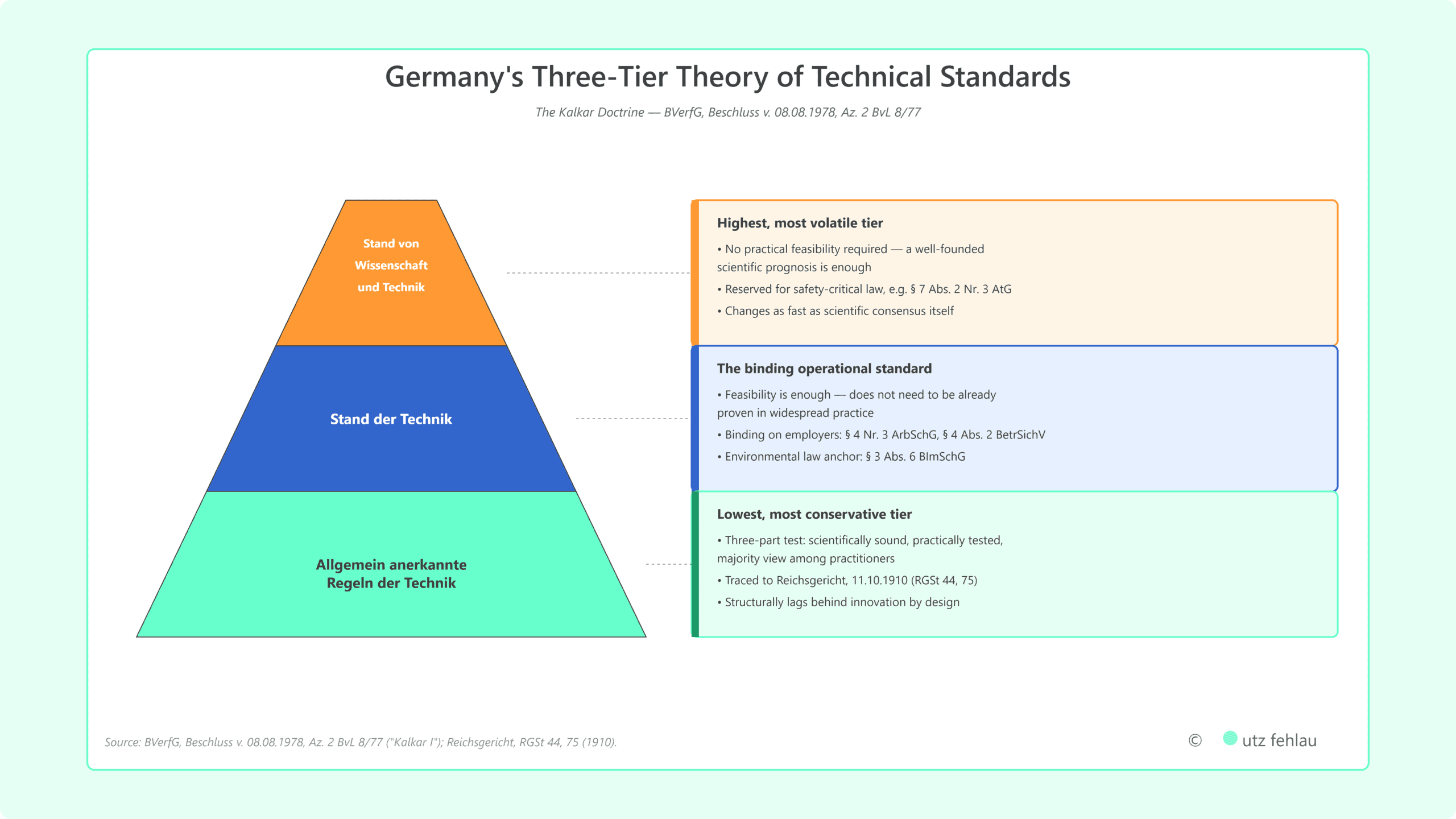
Migrating between these tiers takes time, and a rule can also fall out of the top tier if it stops being maintained — a point the following section illustrates with an actual German court case.
2. How Courts Handle the Gap Between Codified Norms and Current Reality
2.1 A Documented Case: When a DIN Standard Stopped Being „State of the Art“
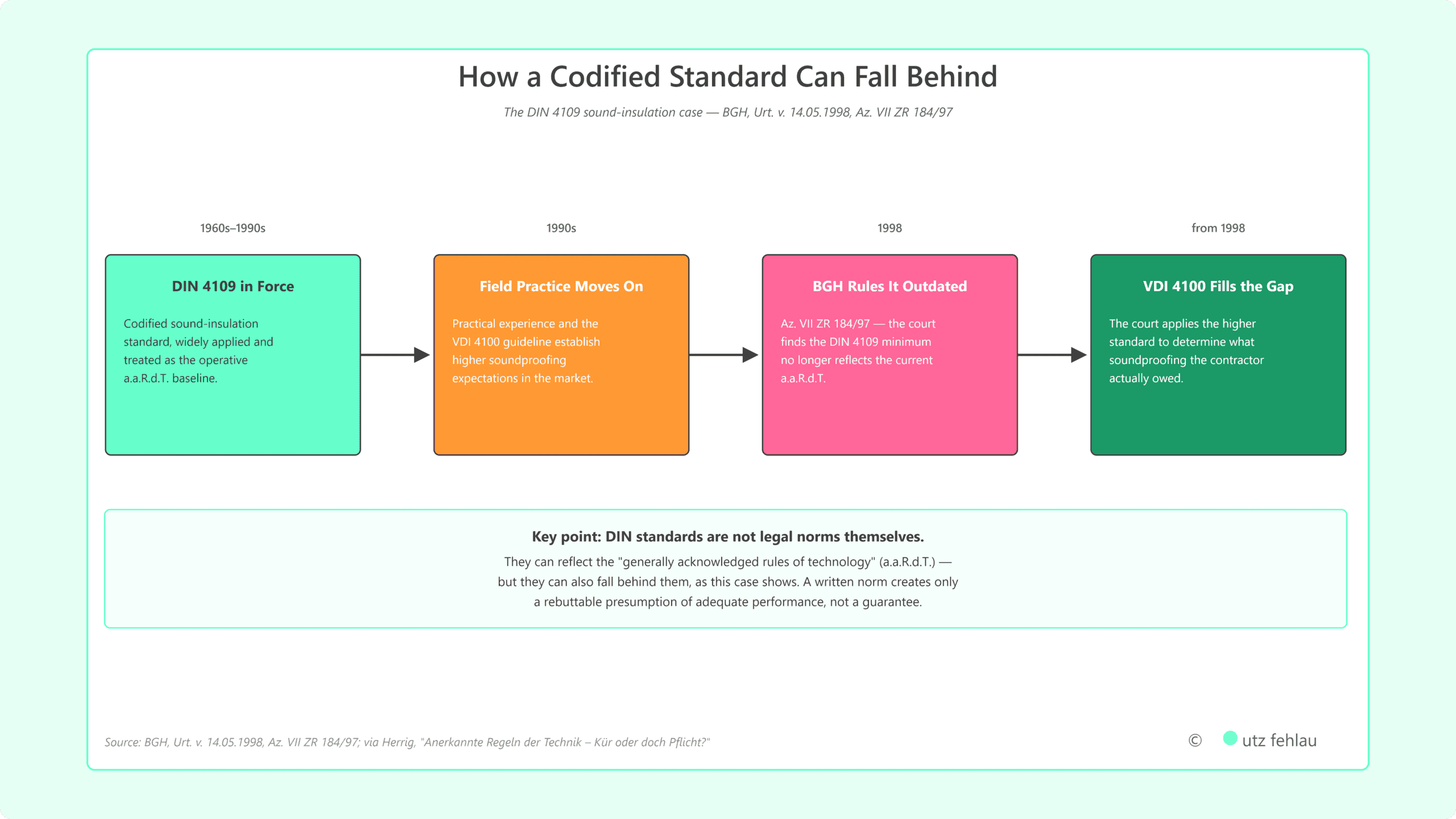
German courts have directly confronted the question of when a written technical standard stops representing the law’s actual requirement. In a landmark 1998 ruling (BGH, Urt. v. 14.05.1998, Az. VII ZR 184/97), Germany’s Federal Court of Justice (Bundesgerichtshof) addressed DIN 4109, the long-standing national standard for sound insulation in buildings. The court held that DIN standards are not themselves legal norms but private technical recommendations without binding force — they can reflect the „generally acknowledged rules of technology,“ but they can also fall behind them. In this case, the court found that DIN 4109’s minimum requirements had become outdated and no longer represented the current a.a.R.d.T.; it supplemented the gap by referring to a more demanding standard (VDI 4100) to determine what level of soundproofing a contractor actually owed.
This is a concrete illustration of the article’s central claim: a codified, widely used standard can be legally superseded even while it remains formally in force. The court did not wait for DIN to update its own standard — it looked at what the field had actually moved toward.
Implication for practice: following an older standard offers no guaranteed protection once courts (or, in the SME context, clients and auditors) recognize that field practice has moved past it. A written norm creates only a rebuttable presumption of adequate performance — it can be challenged with evidence that the norm has become outdated.
2.2 Which Point in Time Counts?
A related and often overlooked question is when the applicable standard is measured. German case law distinguishes between the standard applicable at contract formation and the standard applicable at acceptance of the work: for construction execution, the relevant a.a.R.d.T. is generally the one in force at the time the work is accepted (BGH, Az. VII ZR 65/14); for planning services, however, the standard the client can expect is generally the one in force when the contract was signed — unless a foreseeable change was already apparent at that point (BGH, Urt. v. 14.05.1998, Az. VII ZR 184/97). In other words, a party cannot be held to a standard that changed unpredictably after the relevant commitment was made — but is expected to anticipate a change that was already visible on the horizon. This distinction matters directly for knowledge management: an organization’s KM system is what makes a looming, foreseeable shift visible in time, rather than treating every change as an unpredictable surprise after the fact.
2.3 Example: Supply Chain Legislation (Illustrative, Not Court-Tested)
The German Supply Chain Act (Lieferkettengesetz) is frequently cited as an example of a law that exceeds older ISO-based due-diligence baselines with more demanding statutory requirements. Unlike the DIN 4109 case above, this comparison has not been verified here against an actual court ruling applying the three-tier doctrine to the Lieferkettengesetz specifically — it should be read as an illustrative analogy to the same underlying dynamic, not as an established legal precedent.
Knowledge management matters here because it is what makes such shifts visible in time. A KM process that actively tracks new laws and technical developments allows an organization to adapt quickly, rather than continuing to rely on a standard that has quietly become outdated.
3. Industry Guidelines as Dynamic Benchmarks
3.1 The Advantage of Industry Guides
National and international standards can lag behind real-world developments. Trade and professional associations, by contrast, often publish guidance more quickly, informed by day-to-day practice, emerging technology, and recent case studies. These guidelines can therefore serve as a useful proxy for the current state of the art, even where a formal norm has not yet caught up.
Tip: Cross-check your methods against relevant sector or professional-association guidance as an additional safeguard — these sources often reflect newer thinking than a formal standard still in revision.
3.2 Example: IT Security Measures
An official standard might simply state „use strong encryption.“ An influential IT security association, however, may already be recommending multi-factor authentication or zero-trust architecture. If the market has broadly adopted such measures, a court may treat them as the actual Stand der Technik — even before an older norm has formally caught up.
3.3 The Role of Knowledge Management
A structured knowledge management system helps employees stay current with these shifts. When staff review new technical bulletins or whitepapers and feed them into a shared knowledge base, the organization can act on new information quickly instead of waiting for it to filter down through a formal update cycle.
Recent developments in knowledge management standardization illustrate both the promise and the risk of this dynamic. The 2021 publication of ISO 30401, an international standard for organizational knowledge management systems, and the German DIN SPEC 91443, a companion guideline aimed specifically at SMEs, mark a maturing of the discipline. Researchers involved in early implementation projects have cautioned, however, that formal certification can become an end in itself: organizations may adopt a standard primarily to display compliance rather than to genuinely embed knowledge practices in daily work — the same „check the box“ risk that undermines a static best practice (Will, Orth & Budde, 2023).
4. Best Practice as a Living Concept
4.1 How Knowledge Management Supports Continuous Improvement
Standards, tools, and legal requirements change constantly — often faster than any static „best practice“ manual can be revised. A healthy knowledge management culture allows an organization to course-correct as soon as employees identify something better, rather than waiting for the next formal review cycle. This living approach reflects reality far more accurately than a fixed rulebook.
Such a culture encourages staff to:
- Discover new techniques through conferences, journals, or professional networks.
- Compare new approaches against current internal practice.
- Pilot or adopt promising solutions where it makes sense.
- Document both the results and the reasoning behind any change.
4.2 The Cost of Not Updating
- Legal risk: the organization may no longer meet the actual state of the art, even while believing it is compliant.
- Reputational risk: clients perceive the company as behind the curve, especially as competitors market themselves as more advanced.
- Inefficiency: resources continue to go toward less effective solutions, or simpler alternatives that have since emerged go unnoticed.
4.3 A Metaphor from the Nyquist–Shannon Sampling Theorem
Infobox: What Is the Nyquist–Shannon Sampling Theorem?
This is an engineering principle from signal processing, not a KM concept — but its logic transfers surprisingly well. When a continuous signal (say, an audio wave) is converted into digital form, it isn’t recorded continuously; it’s measured — „sampled“ — at regular intervals. The Nyquist–Shannon theorem states that to capture a signal accurately, you must sample it at least twice as often as its fastest change occurs. Sample too rarely, and something strange happens: the signal doesn’t just become blurry — it gets misread as a completely different, slower-changing signal. This distortion is called aliasing. It’s the same effect behind the classic „wagon-wheel illusion“ in old films, where a fast-spinning wheel appears to rotate slowly, or even backwards, because the camera’s frame rate is too low to keep up with it.
The Nyquist–Shannon sampling theorem states that a high-frequency signal, if sampled too infrequently, produces aliasing — a distorted or misleading picture of the original signal. The same applies to standards: if an organization only „samples“ the state of the art once every few years, it risks missing rapid changes entirely. A continuously updated knowledge base allows for much more frequent „sampling“ of new developments, keeping the picture accurate.
5. Practical Steps for SMEs
5.1 Ongoing Review Cycles
Set up regular check-ins — annually, at minimum — to assess whether current practices still align with the state of the art. This should include:
- Reviewing guidance from relevant industry associations.
- Checking for legal updates.
- Asking staff directly whether better options have emerged.
Document these findings in the knowledge repository, and where a shift is identified, define a plan for testing or adopting the new approach.
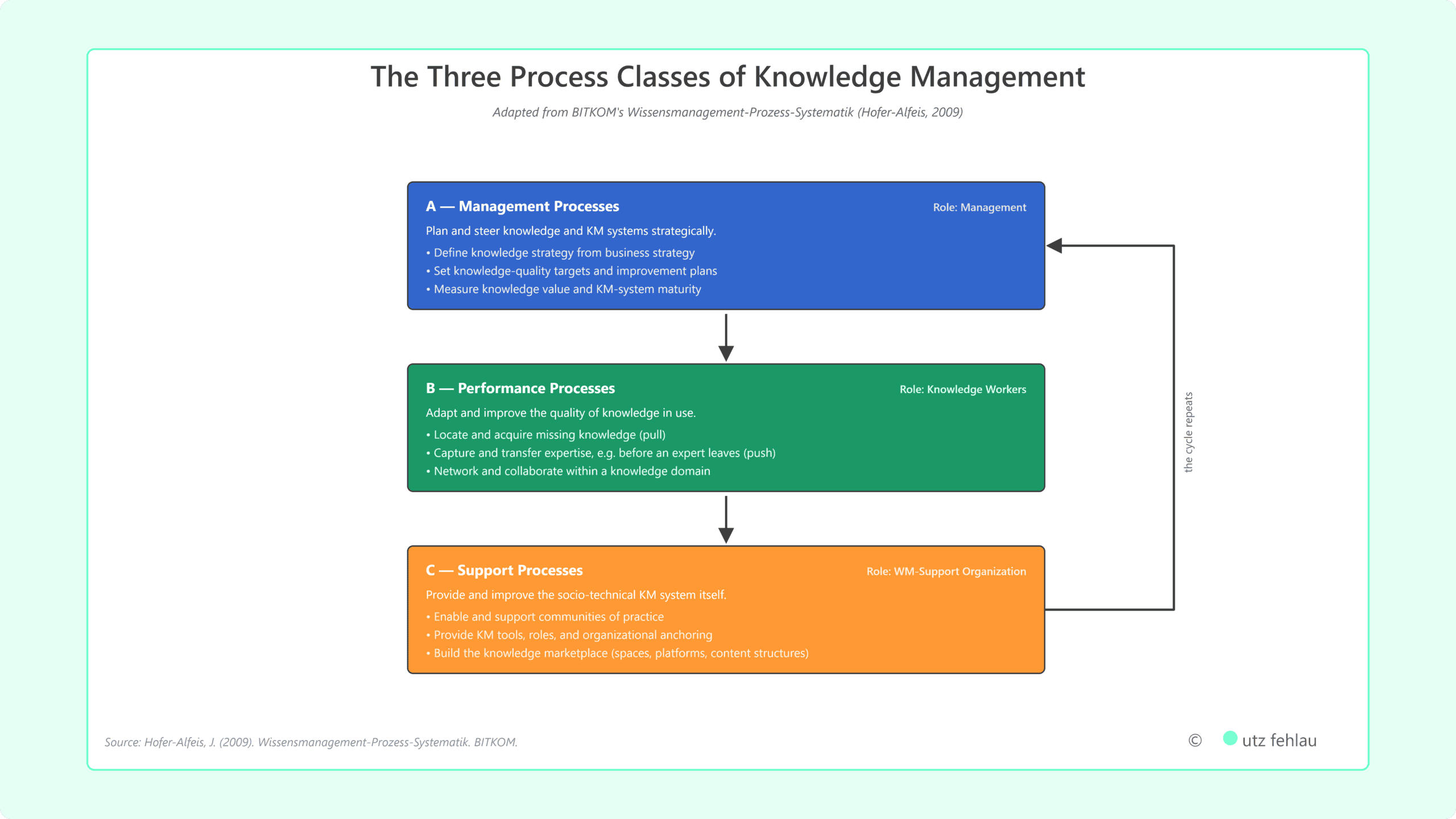
One structured resource SMEs can draw on for this audit is an established process taxonomy such as BITKOM’s Wissensmanagement-Prozess-Systematik, which distinguishes management-level processes (planning and steering knowledge strategy), performance-level processes (adapting knowledge quality), and support-level processes (providing the underlying KM infrastructure). Used as a checklist, it helps identify concretely where a review is overdue rather than relying on a vague sense that „something should be updated“ (Hofer-Alfeis, 2009).
5.2 A Simple In-House Evaluation Method
One practical approach is a basic scoring model that rates each method along two dimensions:
- Acceptance: how widely is this method used or recognized?
- Track record: how long, and how thoroughly, has it been tested in practice?
Plotting results on a simple chart shows where a given method sits: something widely discussed but not yet well-tested still belongs to the „science and research“ tier, while a method that has proven itself over several years of broad use is closer to a generally acknowledged rule of technology. This makes it easy to spot whether your organization’s current approach has drifted into outdated territory.
5.3 Align with Industry Bodies
Check whether your sector’s trade association or a relevant working group issues regular updates — an IT security group publishing monthly guidance, for example. Feeding these bulletins into your knowledge processes ensures you know when to investigate a new technique or a changing practice. Capture them in the knowledge base, share them with relevant staff, and assess their feasibility.
5.4 Document the Rationale
Whenever a new method is adopted, record why. Equally, if a promising approach is rejected — because it’s too costly, or too immature — document that reasoning too. A clear, documented rationale holds up far better in a legal or compliance review than a vague appeal to „it was best practice at the time.“
5.5 Encourage Employee Participation
Staff often encounter new tools or emerging legal interpretations directly in their daily work. Encourage them to share these observations — through an internal wiki, a chat channel, or a regular update — and recognize those contributions. A genuine culture of knowledge-sharing helps an organization notice change earlier, rather than waiting for formal standards to catch up.
6. The Effect on Knowledge Management
6.1 More Than a Repository
A dynamic knowledge base becomes a learning platform — a place that tracks not just how tasks are currently done, but how they should evolve. This forward-looking approach allows an organization to:
- Test new solutions with limited risk.
- Retire outdated „best practices“ that no longer work.
- Alert employees to relevant changes as early as possible.
Empirical research on knowledge management lends some general support to this picture, though with an important limitation worth stating plainly. A survey-based study of 511 Polish SMEs found that KM processes — localizing where knowledge resides, acquiring and developing it, transferring it, codifying it, and applying it — were positively associated with organizational performance, and that this relationship was shaped by both social factors (organizational culture, management support) and technical factors (IT support) (Paliszkiewicz, 2007). This is a real, peer-reviewed finding, and it is consistent with the broad claim that structured KM contributes to organizational performance.
What it does not show, and what this article does not claim to have separately verified, is the more specific mechanism asserted throughout this piece: that systematic knowledge management leads to earlier detection of outdated standards specifically. That causal chain — KM practice → earlier recognition that a given standard, norm, or best practice has become obsolete — is plausible and consistent with the general KM-performance literature, but it has not been empirically isolated and tested as such here. Readers should treat the connection between the legal doctrine described in Sections 1–2 and the KM practices described in Sections 4–7 as a reasoned analogy supported by adjacent evidence, not as a directly demonstrated causal finding.
6.2 Avoiding the „Check the Box“ Trap
Many SMEs treat documentation as a compliance exercise: satisfy the ISO or legal requirement, then move on. That approach ages quickly. If the documentation is never revisited, it stays frozen at whatever level it was written — while the real state of the art continues to move. At that point, the knowledge management system has failed at its core purpose: keeping the organization current.
6.3 Connecting to „Stand der Technik“
Since Stand der Technik sits between the established, consensus-based baseline (allgemein anerkannte Regeln der Technik) and the volatile scientific frontier (Stand von Wissenschaft und Technik), that middle ground is generally where an organization wants to operate: open to newer ideas, but grounded in what is practically feasible rather than merely theoretical. This balance — effective and demonstrably realizable — is typically where SMEs get the best return on their KM investment.
7. Legal and Market Pressure: The Stakes
7.1 Example: The Supply Chain
Consider a small toolmaking company. A new supply-chain law introduces a traceability requirement that goes beyond what an older ISO standard recommends. A company still relying on that older standard is now in violation of the law — while a competitor that has already invested in modern track-and-trace systems meets it. Regulators and courts are likely to treat the competitor’s approach, not the outdated standard, as the real state of the art.
7.2 Real-World Consequences
- Liability: fines or lawsuits when practices fail to meet newer legal requirements.
- Lost business: major clients may favor a competitor that can demonstrate up-to-date compliance.
- Employee frustration: staff asked to keep using outdated or questionable methods are more likely to disengage or leave.
7.3 The Role of Knowledge Management Tools
A robust knowledge system helps an organization track legal and technical updates and route them to the people who need to act on them — HR flagging a new labor standard, R&D identifying a new safety directive. Documenting the requirement, linking it to the relevant processes, and tracking the path to compliance can be the difference between a smooth transition and a costly one.
8. Best Practice Is a Moment, Not a Destination
Best practice reflects a point in time, not a permanent designation. The real question is whether current practices remain comparable to the best available solutions, given today’s industry and legal landscape. In a fast-changing environment, „best“ has to be treated as a moving target — complacency is what creates legal and operational risk.
Knowledge management is what allows an organization to track that target consistently — not just for a single project, but as an ongoing discipline. Combining staff insight, external requirements, and a systematic documentation process is what keeps an organization moving toward genuine best practice, rather than settling into something merely accepted but stale.
What is sufficient today may not be sufficient tomorrow. Building a culture that treats „best practice“ as fluid — one that actively tracks change and shares new insight — is what keeps an organization aligned with evolving norms and laws.
Steps to Get Started
- Audit existing practices against current published guidelines and legal requirements.
- Establish review periods — documentation and methods should be revisited at least annually.
- Involve staff — shorten the feedback loop so new ideas surface quickly.
- Compare solutions using a simple scoring approach to assess whether current practice reflects the real Stand der Technik or has drifted toward an outdated method.
References
Bundesverfassungsgericht (BVerfG), Beschluss v. 08.08.1978, Az. 2 BvL 8/77 („Kalkar I“).
Bundesgerichtshof (BGH), Urt. v. 14.05.1998, Az. VII ZR 184/97 (DIN 4109 / Schallschutz).
Bundesgerichtshof (BGH), Urt. v. 14.11.2017, Az. VII ZR 65/14.
Herrig, T. (n.d.). Anerkannte Regeln der Technik – Kür oder doch Pflicht? Bedeutung von allgemein anerkannten Regeln der Technik und wann die Pflicht zur Anwendung und Einhaltung der Regeln besteht (Langfassung). Rechtsanwalt und Notar, Fachanwalt für Bau- und Architektenrecht, Berlin. www.raherrig.de
Hofer-Alfeis, J. (2009). Wissensmanagement-Prozess-Systematik: Überblick und Checkliste für die Aktivitäten von Wissensmanagement in Organisationen. BITKOM – Bundesverband Informationswirtschaft, Telekommunikation und neue Medien e.V.
Paliszkiewicz, J. (2007). Knowledge management: An integrative view and empirical examination. Cybernetics and Systems: An International Journal, 38(8), 825–836. https://doi.org/10.1080/01969720701601148
Will, M., Orth, R., & Budde, F. (2023). Wieviel Essentials stecken in den neuen Wissensmanagement-Standards? – Ein Erfahrungsbericht. In A. Matern & S. Zillich (Eds.), Knowledge Management Essentials (Das Kuratierte Dossier, Band 5, pp. 26–37). Gesellschaft für Wissensmanagement e.V.
#KnowledgeManagement #StateOfTheArt #SMELeadership #LegalCompliance #ContinuousImprovement